

Hi, my name is Ryan, and I collect baseball cards.
My story might sound similar to yours. I collected cards as a kid, then stopped collecting when life got busy! I enlisted in the military, gave away most of my collection, and went about life. But I got back into card after years away from the hobby and jumped in with both feet! It has been a fun journey, and I started this site to share my passion for the hobby with you!
Why Collect Baseball Cards?
I love baseball, and I love history. To me, baseball cards are the intersection of these two passions. I especially love collecting vintage and autographed baseball cards. Autographed vintage baseball cards? Count me in!
What Do I Collect?
My passion is vintage baseball cards and autographs. I collect some football and basketball cards, but baseball is my first love. My best friend and I attended numerous Houston Astros games at the Astrodome during high school in the late 1990s. We always tried to get there early to get autographs when the players arrived at the player parking lot. Then, when the gates opened, we raced to the visitors’ dugout, where we tried to get more autographs. If the game didn’t go too late, we’d stay afterward and try to get more autographs at the player parking lot, or at the visiting team’s bus.
We got some amazing autographs during those years, including Astros legends like Craig Biggio, Jeff Bagwell, Jose Cruz, Ken Caminiti, Darryl Kyle, Larry Dierker, Shane Reynolds, and many more. We also got some of the game’s greats at the visitor’s dugout, including Hall of Famers and legends of the game, such as Tony Gwynn, Tom Glavine, John Smoltz, Andre Dawson, Dennis Eckersley, Larry Walker, Todd Helton, Mark McGwire, Manny Ramirez, Dusty Baker, and others.
Today, I enjoy sending cards through the mail (TTM) for autographs. I especially enjoy writing to older veterans. To me, autograph collecting is collecting a piece of American history. There is so much history tied to the game of baseball!
Projects I’m Working On
Collecting is more fun when you have a project or goal! Here are some of the long-term projects I’m working on.
- Autographed Topps Cards through the Years (1951 – Present)
- Hall of Fame Autographs
- Autographed Cards that Represent Historic Moments
- Autographed Basketball & Football Cards
Autographed Topps Cards (1951 – Present)
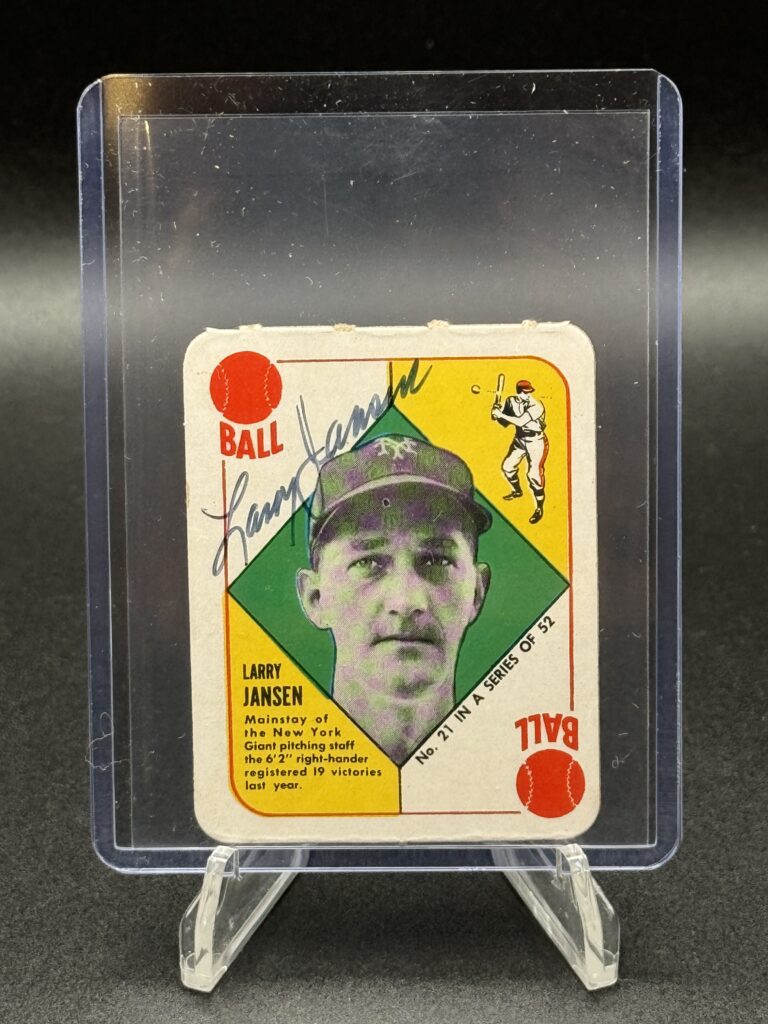
I collect baseball cards for the ties to American history. The one constant in modern baseball cards is the Topps brand. They are the only company that has continuously produced licensed baseball cards since the 1950s, starting in 1951 and continuing through the present.
I also plan to get at least one signed card from each season from the major manufacturers that produced cards during my childhood (Donruss, Fleer, Score, and Upper Deck). But those aren’t as high on my list as completing the signed Topps cards.
I love putting the cards in year order and seeing how the card designs and baseball uniforms have changed through the years. It’s like watching history unfold through a baseball lens.
At least 1 Autographed Topps Base Card from Every Season
Topps first produced baseball cards in 1951. There are no living members from the 1951 Topps sets (Topps Red Backs and Blue Backs). However, at the time of this writing, three living members of the 1952 Topps set still sign autographs through the mail. I’ve been fortunate enough to obtain autographs from all three of them.
Since I started this project, I have obtained TTM autos from 1952 – 2002, and a few cards from more recent seasons. My primary focus has been on older veterans because our time with them is limited, and I want to appreciate their contributions to the game while they are still living. I will fill in the gaps through the present year as I go, but I don’t feel much pressure to get the modern-day cards right away. Many of those can be obtained from pack-pulled certified autographs (though I prefer sending cards off through the mail rather than buying an autographed card that came from a pack).
And thankfully, I have been able to acquire a few autographed 1951 Topps Red Back cards, including cards signed by Bob Feller, Monte Irvin, and Larry Jansen (pictured above). So far, I have over 50 years of autographed Topps cards. It’s a cool collection, and one that I am proud to own!
At least 1 Autographed Topps All-Star Rookie from Every Season
I am collecting at least one signed Topps Card from every season. But when possible, I try to get at least one autographed subset card from each season. Of these subsets, my main focus is autographed All-Star Rookie cards. I started collecting baseball cards in 1987, and the Topps All-Star Rookies (or Rookie Gold Cups, as we called them back then!) always appealed to me.
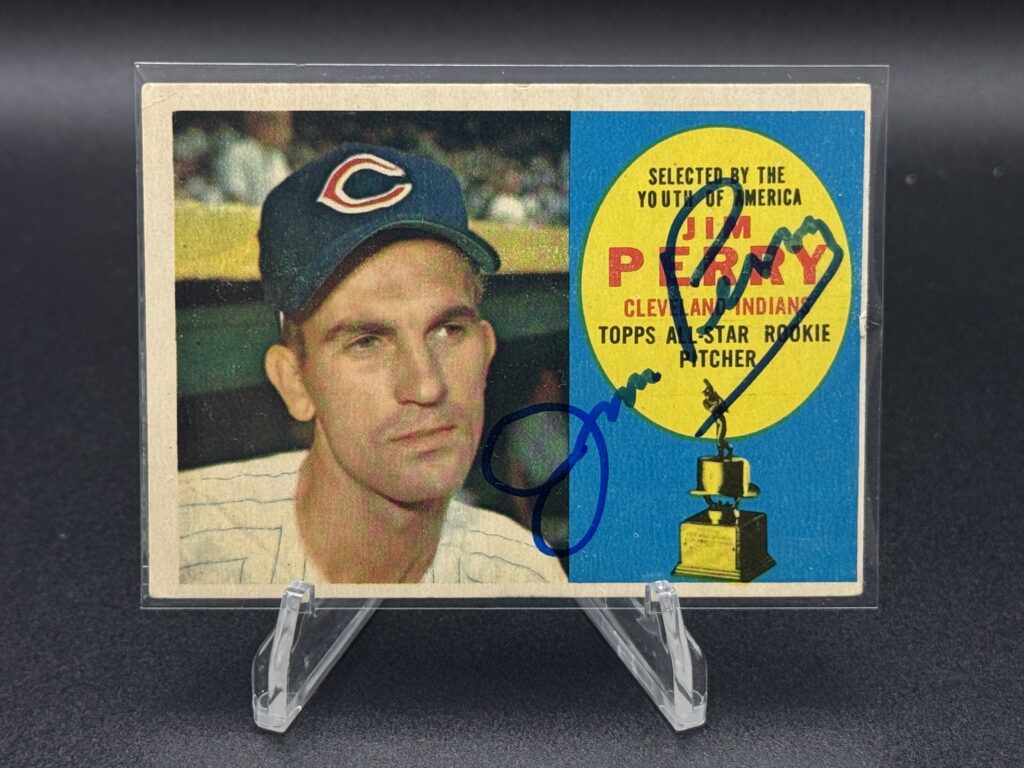
The Topps All-Star Rookie card was first featured in the 1960 Topps set, featuring the rookie card of Hall of Famer Willie McCovey and former Cy Young winner Jim Perry. At the time of this writing, Jim Perry is the only living member of the 1960 Topps All-Star Rookie set.
Topps All-Star Rookie cards feature Trophies or Gold Cups on the cards of players who were selected for the Topps All-Star Rookie team each season. Historically, this was one player from each position, and a left-handed and right-handed pitcher. However, in recent seasons, Topps has included Designated Hitters and Relief Pitchers on some All-Star Rookie teams.
The All-Star Rookie cards featured trophies for many years, before changing to the Rookie Gold Cup we all know and love in the 1973 set.
The Topps All-Star Rookie cards appear from 1960-1978, then 1986-present. There are no All-Star rookie cards from 1979-1986. Additionally, in several years, some players members of the Topps All-Star Rookie Team were issued cards that didn’t include a Trophy or Gold Cup.
Autographed Topps Card Subsets, Oddities, and Unique Cards
Topps has included subsets for many years. The word “subset” is a bit of a loaded term, since there isn’t an official definition that I’m aware of. So, for my purposes, I try to collect at least one non-standard base Topps card from every season. This can include All-Stars, Record Breakers, Highlights, Manager Cards, Team Cards, cards featuring multiple players, etc.
Whenever possible, I would love to collect at least one autographed variation of each type from every season. However, not all years still have living members from each subset. So, it’s difficult to collect all of these through the mail, and some of them are prohibitively expensive. So, I’m working on these as I go.
Hall of Fame Autographs
As far as I am concerned, the Hall of Fame is hallowed ground. To be elected to the Hall of Fame is the greatest professional honor any baseball player can achieve. As fans, we can debate who should or shouldn’t be included in the HOF. But at the end of the day, our vote doesn’t count. So, if they are in the Hall, I want to collect their autograph, if only to say I was able to brush up against greatness, if only through a shared piece of cardboard.
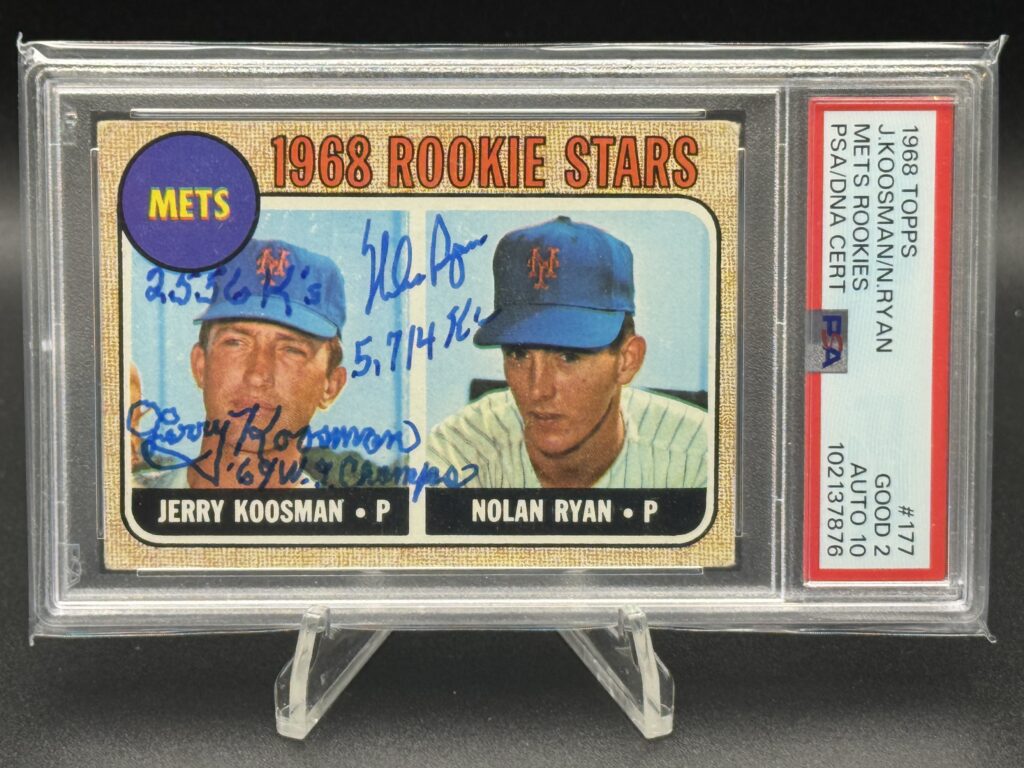
I break my HOF autograph collection into four groups: Autographed Rookie Cards, Autographed Playing Days Cards, Autographed Cards, and Other Autographs (memorabilia, cut autos, etc.).
Autographed Rookie Cards – 1960-Present
I would love to acquire an autographed rookie card from every Hall of Famer. But sadly, that isn’t possible. There are many Hall of Famers who don’t have cards (executives, umpires, etc.). And some players have very few cards, some with no known autographed examples (rookie or not).
Collecting baseball player autographs didn’t come into vogue until the 1920s-30s. But the preferred medium at that time was baseballs and paper. Because baseballs were expensive, it was rare for people to get only one autograph on a ball. Single-signed baseballs were reserved for the game’s elite players.
Due to the rarity of autographed Pre-War cards and the expense of many rookie cards from the 1940s and 1950s, I’ve decided not to worry about trying to collect autographed rookie cards from those years. I will try to acquire them if I can find one at a reasonable cost. But it’s not a priority. 1960 seems like a reasonable cut-off*.
For example, autographed rookie cards exist of Jackie Robinson, Satchel Paige, Mickey Mantle, Willie Mays, Roberto Clemente, Sandy Koufax, and other era luminaries. But the cost of those cards is astronomical and out of the reach of most mere mortals. So, when cards are too expensive, I’ll try to acquire a suitable alternative.
*Some HOF rookie cards after 1960 are also very rare and expensive, especially those of Willie Stargell, Tom Seaver, Catfish Hunter, Rod Carew, Kirby Puckett (84 Fleer XRC), and others. In those cases, I will try to get their second-year card or a similar one. Other options include signed licensed Topps reprint cards, though my preference is a signed playing days card.
Autographed Playing Days Cards
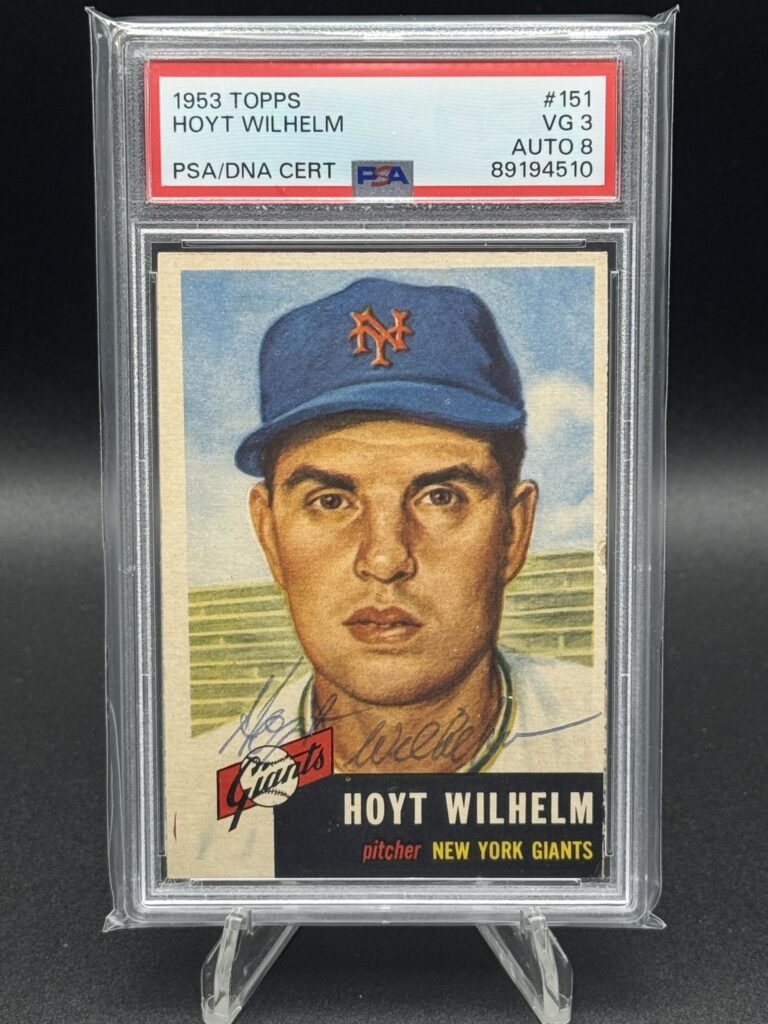
Playing days cards are those issued during the player’s career. A low-end, late-career autographed card of Mickey Mantle might set you back $1,000-$3,000. But a signed rookie card will easily be in the upper five to low six figures. The same concept applies to many other players. Even then, an authentic autographed playing days card of Jackie Robinson or Roberto Clemente can easily set you back more than $10,000. Those cards are unlikely to ever be a part of my collection.
However, I can afford to add signed playing days cards of other baseball greats, such as Willie Mays, Hank Aaron, Bob Gibson, and others. When rookie cards are out of reach, I’ll do my best to obtain a signed playing-days card.
This autographed 1953 Topps Hoyt Wilhelm card is a perfect example of an autographed playing days card. Wilhelm’s 1952 Topps rookie card is in the same scarce high series as Mickey Mantle’s first Topps card and Eddie Mathews’s rookie card.
An unsigned low-grade copy of Wilhelm’s rookie card runs about $1,000 and up. A signed copy of his rookie card usually sells in the $8,000+ range. That’s way out of my budget! So, I’m more than happy to have this beautiful copy of Wilhelm’s second-year card. As a bonus, the 1953 Topps set is one of the most beautiful sets ever produced. I love it!
Eddie Mathews’ rookie card is in the same 1952 Topps series, and is even more expensive than the 1952 Toppps Hoyt Wilhelm card. I don’t yet have a signed 1953 Topps Eddie Mathews card, but I have another playing days card to represent him in my HOF autograph collection.
Autographed HOF Baseball Cards (Post-Playing Days)
This group includes post-playing-days cards, reproductions, reprints, and other cards that were issued after the player’s career ended. These cards may be licensed or unlicensed and are often more affordable than buying signed cards from a player’s career.
In some cases, these cards are very affordable and are readily available. I’ve been able to pick up signed HOF cards for $10 or less in some cases. Good cards to target are the 1960 and 1961 Fleer Greats of the Game sets, 1961 Golden Press, and cards produced by Pacific, Renata Galasso, TCMA, Ted Williams Card Company, Topps reprint cards, unlicensed reprints, and others.
Other HOF Autographs
This category includes cut autographs, autographed baseballs, Perez Steele Galleries, HOF Postcards, and much more. My main focus is on autographed cards. I prefer the uniformity of having as many autographs on the same medium as possible. However, that’s not always possible. As mentioned above, some Hall of Famers don’t have any cards, or if they do, there are either very few or no known autographed copies of those cards.
So, you may have to get creative if you want to collect their autographs. I currently own very few autographs in this category. I only recently started this journey, so I’m focusing on the categories I most enjoy – signed HOF rookie and playing days cards. At some point, I may expand into cut autographs, index cards, postcards, and other media. I’m also intrigued by the growing number of custom card creators who will turn cut autographs into custom baseball cards. Many of these look as nice or better than what some of the major card manufacturers produce.
There are also very few known autograph examples of some members of the Baseball Hall of Fame. I’m not at a point in my financial journey where I can drop tens of thousands of dollars on an autographed piece of paper. I am going through this journey with the understanding that I will never complete it. And I’m ok with that. The journey is the destination for me, and I enjoy the discovery process and the hunt as much as I do having these cards and autographs in my collection.
Future and Potential HOF Autographs
There are some players and managers who are all but certain to be elected to the Hall of Fame. Players like Albert Pujols and Miguel Cabrera quickly come to mind as all-time greats who are certain to be elected to the HOF on their first ballot.
But there are other players who will most likely be elected, or are borderline HOF candidates. I try to get their signed cards, too. There are many potential candidates, but some players I think have a chance to be elected to the Hall of Fame include Jose Altuve, Carlos Beltran, Bryce Harper, Andruw Jones, Aaron Judge, Clayton Kershaw, Shohei Ohtani, Max Scherzer, Justin Verlander, Lou Whitaker, and others.
I also collect Hall of Fame Managers if their cards are reasonably priced. After all, they had an important part in shaping the game on the field. Some potential future HOF managers include Dusty Baker, Bruce Bochy, Terry Francona, and Lou Piniella.
I don’t have signed cards of all of these players and managers, but they are on my short list of autographed cards to acquire.
Hall of Fame Caliber Players – if Not for PED Allegations
Some players have the stats to be in the HOF but have steroid and PED allegations hanging over their heads. These include all-time greats such as Barry Bonds, Roger Clemens, Mark McGwire, Rafael Palmeiro, Manny Ramirez, Alex Rodriguez, Gary Sheffield, Sammy Sosa, and others.
I collect signed baseball cards as my way of documenting baseball history and honoring some of the game’s greats. To leave them out of my collection is to ignore the impact they had on the game. Whether or not they should be in the Hall of Fame is another debate. But I’m good with having their cards in my collection.
Autographed Cards That Represent Historic Moments or Achievements
As mentioned above, I love the intersection of baseball and history. For my purposes, I love collecting cards that touch on historic baseball moments. I especially love cards with inscriptions.
Here are some examples of the types of cards I collect:
- Cards with inscriptions for awards such as Rookie of the Year (ROY), Cy Young, Hall of Fame, Gold Gloves, All-Star Selections, etc.
- Inscriptions that indicate historic moments (such as baseball’s first Draft Pick, first DH, a historic home run, etc.)
- Cards of players who had a lasting impact on the game, record holders, and others who hold a unique spot in baseball history.
- Autographs of military veterans who played in the Majors.
- Multi-Player Signed Cards. I love getting cards signed by 2, 3, or 4 players. There are some very cool multiplayer cards. They are fun projects to work on.
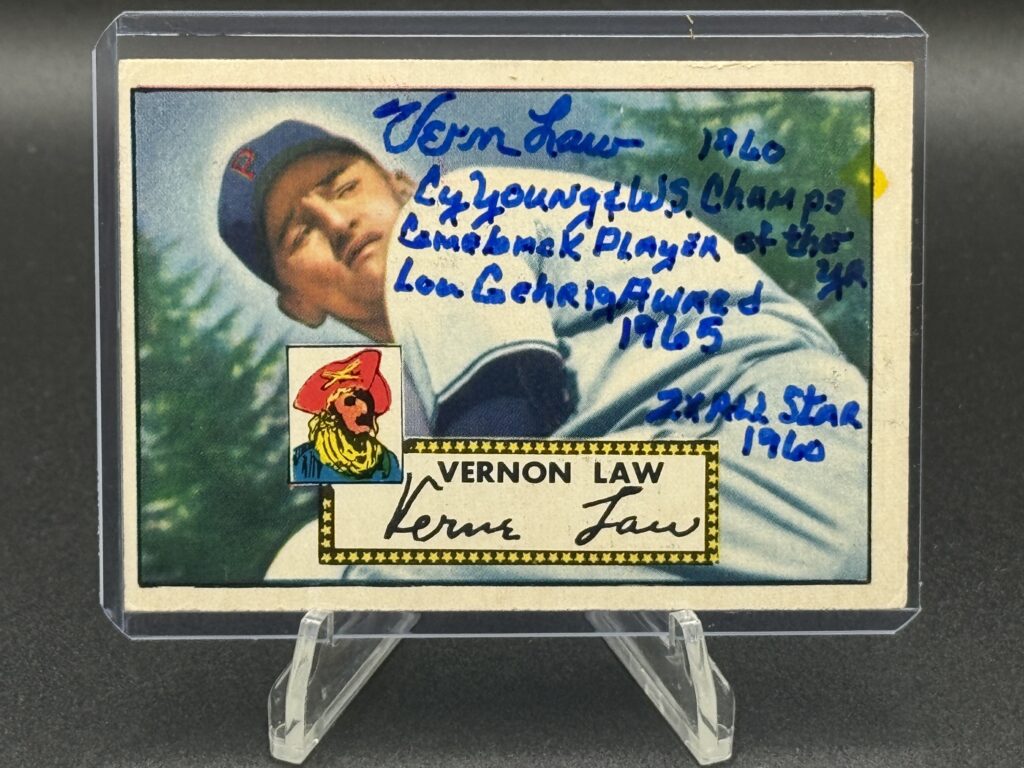
I love this 1952 Topps Vern Law, which includes the following inscriptions:
- 1960 Cy Young & World Series Champs
- Comeback Player of the Year
- Lou Gehrig Award 1965
- 2x All-Star 1960
How awesome is that for a career retrospective on one of the most iconic baseball card sets ever made!
Autographed Basketball & Football Cards
I collect a limited number of basketball and football cards. I don’t follow these sports closely. But I appreciate their spot in America’s history. Whenever possible, I collect cards of players who had a notable impact on the game or who participated in an historic moment.
Most of the cards in my basketball and football collection are in their respective Hall of Fame. It’s amazing how attainable some of these vintage autographed cards are for many basketball and football players.
The inner circle Hall of Famers are expensive regardless of which sport you are interested in. But some of the lesser-known Hall of Famers are readily available and very affordable.
Non-Autographed Vintage Baseball Cards
Autographed cards are my first love. But it’s not possible to get every card signed. So I collect what I can. Many baseball cards from the early years are works of art in their own right. I especially love the 1950 Bowman through 1956 Topps cards. The artwork on those cards is exceptional and a great piece of Americana.
I consider vintage baseball cards to be anything before 1980, but everyone has their own definition. I collect cards from after 1980, too, but in more limited numbers.
I know it’s very unlikely that I’ll own a signed Jackie Robinson card in the near future (if ever!). But I can afford to buy one of his playing days cards. So, rather than omitting Jackie Robinson from my collection, I traded for his 1956 Topps card*, representing the last card that Topps printed of him. It’s arguably his most beautiful card, too. This is the Jackie Robinson card in my Hall of Fame collection, and I couldn’t be happier to own it.
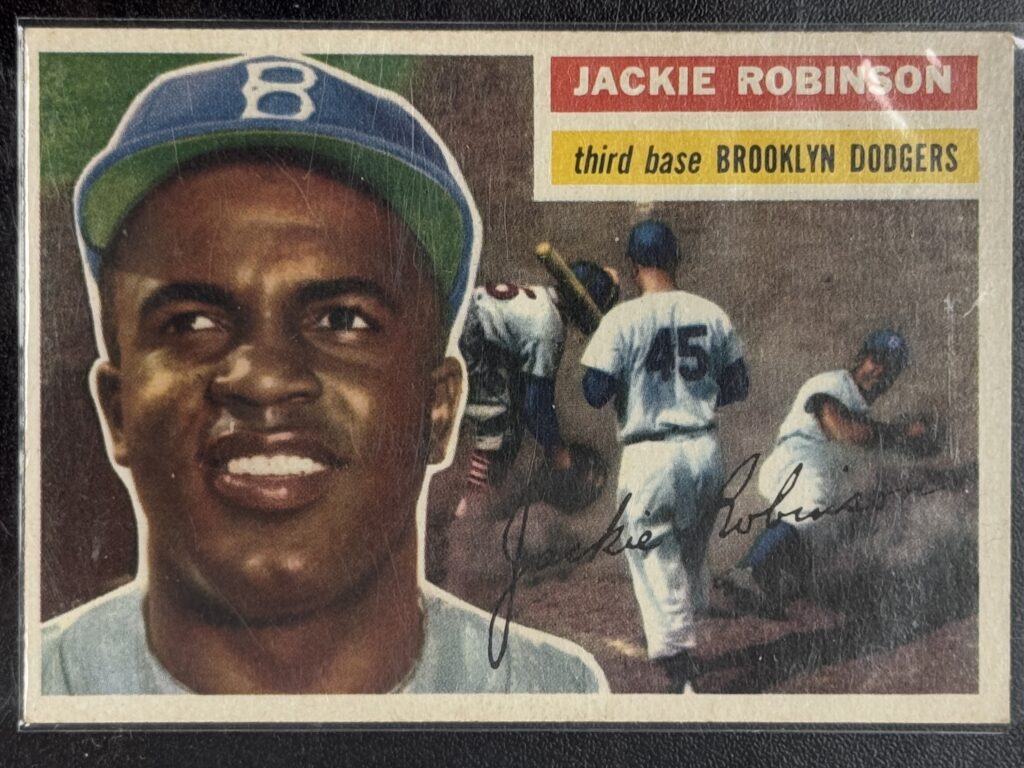
*I traded a Nolan Ryan rookie card and $100 cash. Overall, it was a fair deal for both parties.
…And Some Modern Cards, too
Finally, I do collect a few modern cards. But they aren’t my focus. I collect some cards from the Junk Wax era (typically the mid-80s through around 2000). That was the period when I collected as a kid, so the nostalgia factor appeals to me.
I only collect ultra-modern cards in a more limited way (ultra-modern being anything in the last 5-10 years). I have a handful of Astros cards, including my favorites, Yordan Alvarez and Jose Altuve. And I have a few cards of Kyle Tucker, Alex Bregman, Yainer Diaz, Jeremy Pena, etc. But I haven’t put much time or money into collecting most modern players.
One of the things I love about vintage cards, apart from the history, is that the players have already finished their careers. They aren’t a torn ACL, Tommy John surgery, or scandal away from a ruined career. I’ve watched people pump thousands of dollars into modern cards, only to watch those cards plummet in value due to a serious injury, performance fallout, or terrible scandal.
I collect modern cards for the fun of it, but I avoid dropping significant sums of cash on them. I’ll let others take that risk and focus on the areas mentioned above. Right now, that is where I choose to focus my limited time, money, and other resources.
Note: All photographs taken from my personal collection.
Leave a Reply